How Therapy Can Help Resolve Trauma
How Therapy Can Help Resolve Trauma

How Therapy Helps Resolve Trauma
Trauma isn't only about what happened. It's also about what happens afterward — the way the mind and body can keep responding to danger long after the danger has passed. A sound, a smell, a tone of voice can suddenly put you right back there, even years later, even when you know, logically, that you're safe.
This is one of the most misunderstood things about trauma: it isn't a matter of willpower, and it isn't something people simply choose to move on from. But it is something therapy can help resolve — not by erasing what happened, but by helping the mind and body finally finish processing it.
What Unresolved Trauma Can Look Like

For many people, trauma doesn't stay neatly in the past. It can show up as a nervous system that's constantly on alert, scanning for danger even in safe situations. It can look like intrusive memories that arrive uninvited, or the opposite — a kind of emotional flatness, as though certain feelings have been muted to make them more bearable. It can mean avoiding people, places, or situations that feel connected to what happened, or finding it hard to trust, relax, or feel fully present, even in good moments.
None of this means something is wrong with you. It means your nervous system did exactly what it was designed to do in an overwhelming situation, and hasn't yet gotten the signal that it's safe to stand down.
Why Trauma Gets "Stuck"
Ordinarily, the brain processes an experience and files it away as a memory — something that happened, with a beginning, middle, and end. Trauma can interrupt that process. When an experience overwhelms your capacity to cope in the moment, the memory can stay unprocessed, still carrying the same intensity and urgency as when it happened. Instead of becoming something you remember, it can remain something you keep, in some sense, re-experiencing.
This is part of why trauma responses often feel disproportionate to a present-day trigger. It's not that a slammed door is dangerous — it's that some part of your nervous system hasn't yet learned the difference between then and now.
How Therapy Helps
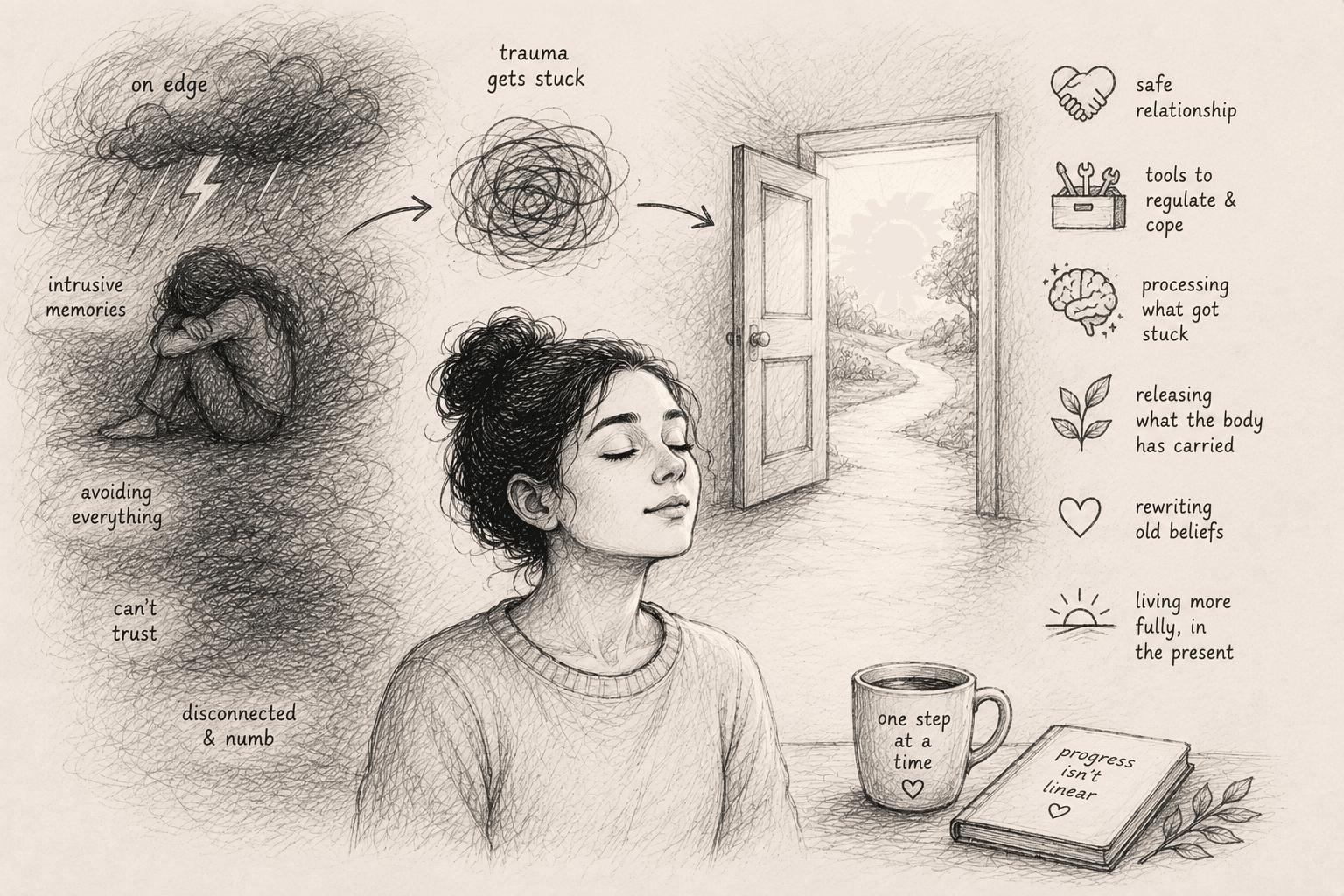
Good trauma therapy rarely starts by asking someone to relive what happened in detail. It usually starts with safety and stabilization — building a trusting relationship with a therapist, developing tools to manage overwhelming emotions, and making sure there's enough stability and support to do the deeper work without becoming overwhelmed by it.
From there, different approaches help the mind and body finally process what got stuck. Some, like EMDR, use guided eye movements or other forms of bilateral stimulation to help the brain reprocess traumatic memories. Others, like trauma-focused cognitive behavioral therapy, work with the thoughts and beliefs that formed around the experience — beliefs like "it was my fault" or "I can't trust anyone." Somatic approaches focus on the body directly, helping release the physical tension and survival energy trauma can leave behind.
The specific method matters less than what all effective trauma therapy shares: a pace that respects what a person can handle, and a relationship safe enough to make the processing possible in the first place. Often, the therapeutic relationship itself — being truly seen and believed — is part of what helps rewrite what the experience taught someone about safety and connection.
Healing Isn't Linear
Progress in trauma therapy rarely moves in a straight line. There can be weeks that feel like real breakthroughs, followed by a hard day that seems to undo it. That's not a sign therapy isn't working — it's a normal part of a mind and body slowly recalibrating what safety feels like.
Over time, the goal isn't to forget what happened. It's to change the relationship to it: for the memory to become something a person carries, rather than something that keeps happening to them.
Reaching Out
You don't need a complete narrative of what happened, or even the right words for it, to start therapy. Trauma-informed therapists are trained to work at a pace that feels manageable, and reaching out isn't a sign that something is wrong with you — it's a sign of being ready to stop carrying it alone.
This article is for general information only and isn't a substitute for individualized care. If you're in crisis or in immediate danger, please contact emergency services or a crisis line in your area.
How Therapy Helps Resolve Trauma
Trauma isn't only about what happened. It's also about what happens afterward — the way the mind and body can keep responding to danger long after the danger has passed. A sound, a smell, a tone of voice can suddenly put you right back there, even years later, even when you know, logically, that you're safe.
This is one of the most misunderstood things about trauma: it isn't a matter of willpower, and it isn't something people simply choose to move on from. But it is something therapy can help resolve — not by erasing what happened, but by helping the mind and body finally finish processing it.
What Unresolved Trauma Can Look Like
For many people, trauma doesn't stay neatly in the past. It can show up as a nervous system that's constantly on alert, scanning for danger even in safe situations. It can look like intrusive memories that arrive uninvited, or the opposite — a kind of emotional flatness, as though certain feelings have been muted to make them more bearable. It can mean avoiding people, places, or situations that feel connected to what happened, or finding it hard to trust, relax, or feel fully present, even in good moments.
None of this means something is wrong with you. It means your nervous system did exactly what it was designed to do in an overwhelming situation, and hasn't yet gotten the signal that it's safe to stand down.
Why Trauma Gets "Stuck"
Ordinarily, the brain processes an experience and files it away as a memory — something that happened, with a beginning, middle, and end. Trauma can interrupt that process. When an experience overwhelms your capacity to cope in the moment, the memory can stay unprocessed, still carrying the same intensity and urgency as when it happened. Instead of becoming something you remember, it can remain something you keep, in some sense, re-experiencing.
This is part of why trauma responses often feel disproportionate to a present-day trigger. It's not that a slammed door is dangerous — it's that some part of your nervous system hasn't yet learned the difference between then and now.
How Therapy Helps
Good trauma therapy rarely starts by asking someone to relive what happened in detail. It usually starts with safety and stabilization — building a trusting relationship with a therapist, developing tools to manage overwhelming emotions, and making sure there's enough stability and support to do the deeper work without becoming overwhelmed by it.
From there, different approaches help the mind and body finally process what got stuck. Some, like EMDR, use guided eye movements or other forms of bilateral stimulation to help the brain reprocess traumatic memories. Others, like trauma-focused cognitive behavioral therapy, work with the thoughts and beliefs that formed around the experience — beliefs like "it was my fault" or "I can't trust anyone." Somatic approaches focus on the body directly, helping release the physical tension and survival energy trauma can leave behind.
The specific method matters less than what all effective trauma therapy shares: a pace that respects what a person can handle, and a relationship safe enough to make the processing possible in the first place. Often, the therapeutic relationship itself — being truly seen and believed — is part of what helps rewrite what the experience taught someone about safety and connection.
Healing Isn't Linear
Progress in trauma therapy rarely moves in a straight line. There can be weeks that feel like real breakthroughs, followed by a hard day that seems to undo it. That's not a sign therapy isn't working — it's a normal part of a mind and body slowly recalibrating what safety feels like.
Over time, the goal isn't to forget what happened. It's to change the relationship to it: for the memory to become something a person carries, rather than something that keeps happening to them.
Reaching Out
You don't need a complete narrative of what happened, or even the right words for it, to start therapy. Trauma-informed therapists are trained to work at a pace that feels manageable, and reaching out isn't a sign that something is wrong with you — it's a sign of being ready to stop carrying it alone.
This article is for general information only and isn't a substitute for individualized care. If you're in crisis or in immediate danger, please contact emergency services or a crisis line in your area.
Blog

What To Expect in Your First Therapy Session
What To Expect in Your First Therapy Session
How Therapy Can Help Resolve Trauma
How Therapy Can Help Resolve Trauma

Setting Boundaries Without Guilt
Setting Boundaries Without Guilt

Why Rest Feels Unproductive?
Why Rest Feels Unproductive?

How to Stop Overthinking Everything
How to Stop Overthinking Everything

Website by: Shivangi Agarwal
Website by: Shivangi Agarwal