Why Rest Feels Unproductive?
Why Rest Feels Unproductive?

For something that's supposed to help us, rest can feel surprisingly uncomfortable.You finally sit down after a long day, and within minutes your mind starts making a list of everything you haven't done. Emails. Laundry. That project you've been putting off. Before long, relaxing starts to feel irresponsible, and instead of feeling restored, you end up feeling guilty.
If you've ever felt like you have to earn your rest, you're far from alone. The truth is, for many people, the hardest part of resting isn't finding the time. It's believing they deserve to.
When Productivity Becomes Part of Your Identity
Many of us grow up receiving praise for what we accomplish rather than simply for who we are. Good grades. Being dependable. Working hard. Always helping others. Over time, it's easy for the brain to make an unconscious connection:
"If I'm productive, I'm valuable."
When that belief takes root, resting can begin to feel like the opposite of being valuable. Even when the body is exhausted, the mind keeps searching for the next thing to accomplish.
That's why lying on the couch can sometimes feel more stressful than answering one more email.
Your Nervous System Doesn't Know How to Slow Down
Sometimes the discomfort isn't just psychological.
If you've spent months—or years—living under constant stress, your nervous system adapts to functioning in high gear. Busyness becomes familiar. Constant stimulation becomes normal.
When everything suddenly becomes quiet, your body may interpret that stillness as unfamiliar rather than safe.
It's a little like stepping off a moving treadmill. Even after you've stopped, your body still expects to keep moving.
This is one reason people often reach for their phone within seconds of sitting down. It's not always boredom—sometimes it's a nervous system trying to avoid slowing down.
Rest Isn't the Same as Doing Nothing
Many people imagine rest as lying in bed for hours.
But real rest comes in many forms.
Sometimes it's taking a slow walk without checking your phone.
Sometimes it's reading a novel simply because you enjoy it.
Sometimes it's spending time with people who make you feel safe.
Sometimes it's sitting quietly with a cup of tea while doing absolutely nothing at all.
The common thread isn't inactivity.
It's giving your mind and body permission to stop performing.
Why Guilt Doesn't Mean You're Doing Something Wrong
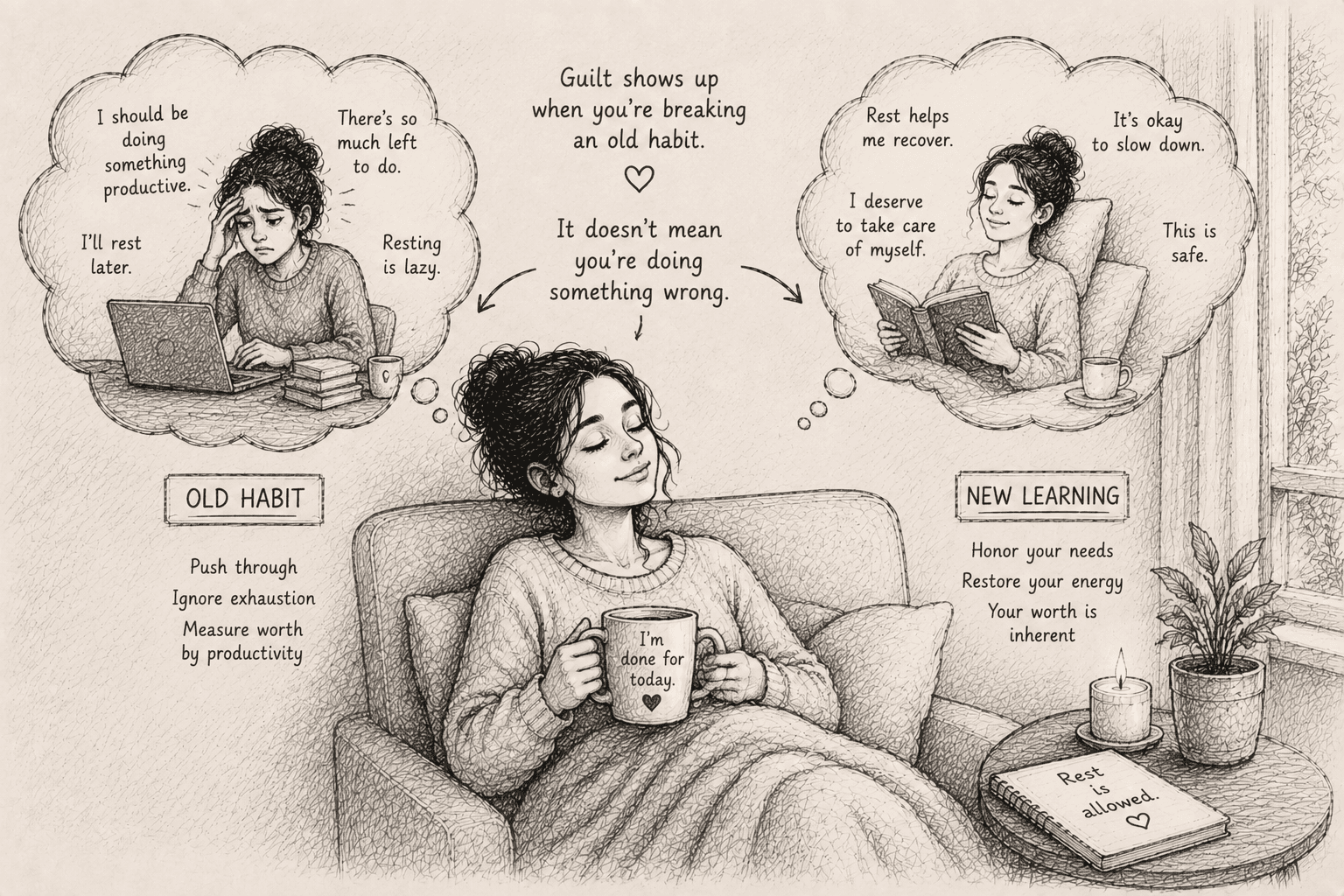
One of the biggest misconceptions about rest is believing that guilt is evidence you've made the wrong choice.
More often, guilt is simply the feeling that appears when you're breaking an old habit.
If you've always pushed through exhaustion, saying "I'm done for today" can feel uncomfortable.
That discomfort doesn't mean resting is a mistake.
It usually means you're practicing something your brain hasn't learned to see as safe yet.
Getting Better at Rest
Learning to rest isn't about forcing yourself to stop overnight.
Like any habit, it becomes easier with practice.
Start small.
Instead of trying to dedicate an entire day to relaxing, begin with ten or fifteen uninterrupted minutes where you intentionally choose not to be productive.
Notice what thoughts show up.
Rather than arguing with them, simply acknowledge them:
"There's the part of me that thinks I should be working."
Then gently return your attention to the present moment.
Over time, your nervous system begins to learn that slowing down doesn't create danger—it creates recovery.
Remember: Rest Is Productive
It may sound paradoxical, but rest is one of the most productive things you can do.
Sleep strengthens memory and learning.
Breaks improve focus.
Downtime supports creativity and problem-solving.
Even athletes understand that muscles grow during recovery—not while they're being worked.
Your mind works the same way.
Rest isn't the reward for productivity.
It's part of what makes productivity sustainable in the first place.
A Different Way to Think About Rest
Instead of asking,
"Have I done enough to deserve a break?"
Try asking,
"What does my mind and body need right now?"
That small shift moves rest away from being something you earn and toward being something you care for.
Because you're not a machine designed to produce endlessly.
You're a human being.
And human beings aren't meant to perform every moment of every day.
This article is for general information only and isn't a substitute for individualized mental health care. If feelings of exhaustion, burnout, or chronic stress are significantly affecting your daily life, consider speaking with a licensed mental health professional.
For something that's supposed to help us, rest can feel surprisingly uncomfortable.You finally sit down after a long day, and within minutes your mind starts making a list of everything you haven't done. Emails. Laundry. That project you've been putting off. Before long, relaxing starts to feel irresponsible, and instead of feeling restored, you end up feeling guilty.
If you've ever felt like you have to earn your rest, you're far from alone. The truth is, for many people, the hardest part of resting isn't finding the time. It's believing they deserve to.
When Productivity Becomes Part of Your Identity
Many of us grow up receiving praise for what we accomplish rather than simply for who we are. Good grades. Being dependable. Working hard. Always helping others. Over time, it's easy for the brain to make an unconscious connection:
"If I'm productive, I'm valuable."
When that belief takes root, resting can begin to feel like the opposite of being valuable. Even when the body is exhausted, the mind keeps searching for the next thing to accomplish.
That's why lying on the couch can sometimes feel more stressful than answering one more email.
Your Nervous System Doesn't Know How to Slow Down
Sometimes the discomfort isn't just psychological.
If you've spent months—or years—living under constant stress, your nervous system adapts to functioning in high gear. Busyness becomes familiar. Constant stimulation becomes normal.
When everything suddenly becomes quiet, your body may interpret that stillness as unfamiliar rather than safe.
It's a little like stepping off a moving treadmill. Even after you've stopped, your body still expects to keep moving.
This is one reason people often reach for their phone within seconds of sitting down. It's not always boredom—sometimes it's a nervous system trying to avoid slowing down.
Rest Isn't the Same as Doing Nothing
Many people imagine rest as lying in bed for hours.
But real rest comes in many forms.
Sometimes it's taking a slow walk without checking your phone.
Sometimes it's reading a novel simply because you enjoy it.
Sometimes it's spending time with people who make you feel safe.
Sometimes it's sitting quietly with a cup of tea while doing absolutely nothing at all.
The common thread isn't inactivity.
It's giving your mind and body permission to stop performing.
Why Guilt Doesn't Mean You're Doing Something Wrong
One of the biggest misconceptions about rest is believing that guilt is evidence you've made the wrong choice.
More often, guilt is simply the feeling that appears when you're breaking an old habit.
If you've always pushed through exhaustion, saying "I'm done for today" can feel uncomfortable.
That discomfort doesn't mean resting is a mistake.
It usually means you're practicing something your brain hasn't learned to see as safe yet.
Getting Better at Rest
Learning to rest isn't about forcing yourself to stop overnight.
Like any habit, it becomes easier with practice.
Start small.
Instead of trying to dedicate an entire day to relaxing, begin with ten or fifteen uninterrupted minutes where you intentionally choose not to be productive.
Notice what thoughts show up.
Rather than arguing with them, simply acknowledge them:
"There's the part of me that thinks I should be working."
Then gently return your attention to the present moment.
Over time, your nervous system begins to learn that slowing down doesn't create danger—it creates recovery.
Remember: Rest Is Productive
It may sound paradoxical, but rest is one of the most productive things you can do.
Sleep strengthens memory and learning.
Breaks improve focus.
Downtime supports creativity and problem-solving.
Even athletes understand that muscles grow during recovery—not while they're being worked.
Your mind works the same way.
Rest isn't the reward for productivity.
It's part of what makes productivity sustainable in the first place.
A Different Way to Think About Rest
Instead of asking,
"Have I done enough to deserve a break?"
Try asking,
"What does my mind and body need right now?"
That small shift moves rest away from being something you earn and toward being something you care for.
Because you're not a machine designed to produce endlessly.
You're a human being.
And human beings aren't meant to perform every moment of every day.
This article is for general information only and isn't a substitute for individualized mental health care. If feelings of exhaustion, burnout, or chronic stress are significantly affecting your daily life, consider speaking with a licensed mental health professional.
Blog

What To Expect in Your First Therapy Session
What To Expect in Your First Therapy Session

How Therapy Can Help Resolve Trauma
How Therapy Can Help Resolve Trauma

Setting Boundaries Without Guilt
Setting Boundaries Without Guilt
Why Rest Feels Unproductive?
Why Rest Feels Unproductive?

How to Stop Overthinking Everything
How to Stop Overthinking Everything

Website by: Shivangi Agarwal
Website by: Shivangi Agarwal